
Thursday, February 5th, 2026, I had my second Spontaneous Coronary Artery Dissection (SCAD). Interestingly, it was almost ten years since my first SCAD heart attack. I knew what was happening this time. I did not know in 2016 that I was having a heart attack.
What is SCAD? Spontaneous Coronary Artery Dissection (SCAD) is a little-known and poorly understood type of heart attack caused when a sudden tear happens within the layers of one or more of the arteries to the heart. This tear blocks blood flow, causing a heart attack and sometimes death. Unlike a “traditional” heart attack caused by a blockage due to plaque buildup over a lifetime, SCAD is a completely distinct and different artery blockage.
Why is it important to know that this type of heart attack is different than the typical ones we see in the movies and hear about? I, like many other women, have been told that we were not having a heart attack because of how we looked, we were too young, our EKG was fine, our chest x-ray was fine, etc. However, because this type of heart attack presents differently, it is important that medical professionals, especially Emergency Room physicians, are aware of SCAD.
In 2016, when I had my first SCAD, I was getting ready for work. I did feel a sharp pain go down my left arm, but my pain was between my shoulder blades. I drove myself to the local hospital and was taken back. My EKG and chest X-ray were both clear. The female doctor in the ER dismissed me, told me it was heartburn (pain was not in my chest), and told me there was no way I could be having a heart attack. She said I was young (40) and in shape without a history of diabetes. I went home. I could not lie down, the pain increased, and about two hours later, I drove myself back. I was seen by a different physician, and my troponin level (a heart enzyme) was measured. The physician informed me that my heart enzyme should be 0.002, but mine was 36.00. He let me know I was having a heart attack and needed to be transferred to another hospital. I was transferred to Cedars-Sinai Hospital, to the ICU.
At first, I was diagnosed with Broken Heart Syndrome. Yes, it is real. I was currently going through a bad divorce. However, once they did the Angiogram, they found that not only did I have a SCAD but that I also had Microcardiovascular Disease. My micro arteries were spasming out of control. Not only did I find this out, but Cedars-Sinai sent my Angiogram to the Mayo Clinic, and I was diagnosed with Fibromuscular Dysplasia (FMD). A lot of women who have SCAD also have FMD and other conditions like Ehlers-Danlos.
When I was finally released from the hospital, I was put in touch with Ellen, a contact at SCAD Research in San Diego. Ellen made me feel so much better about having a SCAD Heart Attack. I didn’t feel alone. I was told SCAD was rare and that, until recently, it was usually found at autopsy. Through Ellen, I have met numerous women who also have survived a SCAD Heart Attack. I have done the yearly walk for SCAD. A 5k in San Diego next to the water with other SCAD survivors, their families, and those walking in memory of someone who died as a result of their SCAD. The gratitude at these events is felt.
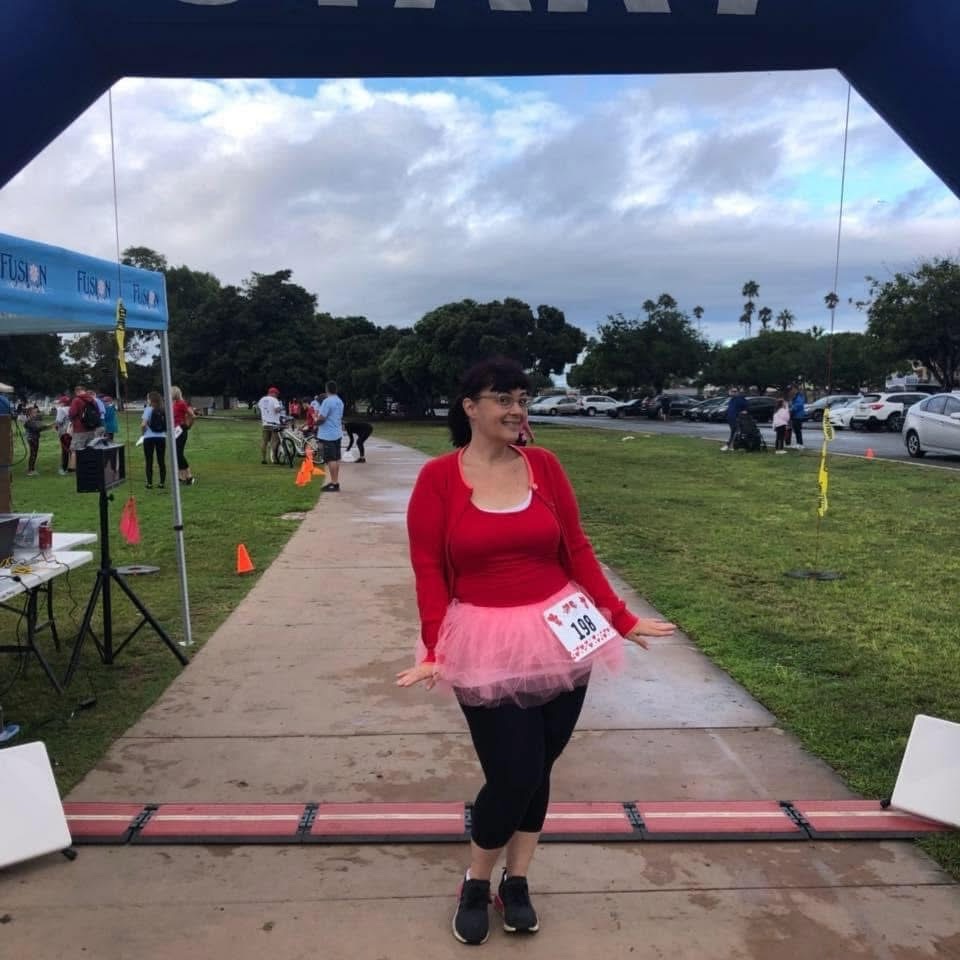
Once I became more involved in ensuring that women knew to advocate for their health, I began to heal even more. I have attended numerous SCADdales since my first SCAD in 2016. It is an event filled with so much gratitude. There are very few men with SCAD, but at these walks, a few have had one.
Being told two times now that I was not having a heart attack when I was, makes me realize that medical professionals, especially, do not know much about SCAD. A SCAD heart attack is generally found through an Angiogram and Troponin levels. So, who has SCAD?
Who has SCAD?
Most are YOUNG, HEALTHY, ACTIVE women. The average age is 42.
SCAD is the #1 cause of Heart Attacks in women under the age of 50.
SCAD is the #1 cause of Heart Attacks in New Mothers and Pregnant women.
Often, there is no family history of heart disease.
Although less common, SCAD can affect Men too. (I’ve met two)
Many have abnormalities of other arteries, most commonly Fibromuscular Dysplasia FMD (I have this rare artery condition)
How is SCAD treated?
There is still no known cause and no way to prevent SCAD. Research has identified several associated conditions and shown that patients with acute SCAD should be treated differently from other heart attack patients. Diagnosing and treating SCAD is more complex than traditional heart attacks.
I at times feel like I am a broken record, that I speak a lot on SCAD, but the reality is that even in 2026, women are treated differently than men when seen in an Emergency room. Because of this, I am a broken record, and my hope is that if another woman is in my situation, she will advocate for herself and not be sent home, that medical professionals will take them seriously and check their troponin. A simple blood test can save lives, and, along with an EKG and Chest X-Ray, it should be done whenever anyone comes into an Emergency room displaying heart attack symptoms.
There is still more research that needs to be done, but until then, I, like other women and men who have had a SCAD, can continue to let others know about our experience so we can possibly save a life.
 moimemoi
Your Thoughts?